

How much can dispatch operations for field service technicians be optimized? We conducted a hands-on test using CSOne’s automatic dispatch feature. In this case, we focused on scheduled maintenance.
The assumed use case is a service department of a manufacturer producing standardized products, or a service company.
*Standardized products: Not custom-made items, but products with common failure patterns and required skill sets, with over 100 installations within each service territory.
Some companies handle hundreds of maintenance jobs per month at each dispatch center. Assigning these hundreds of jobs to dozens of technicians is like solving a complex 3D puzzle.
To create an optimal and efficient schedule, a wide range of constraints must be considered—such as customer locations, available time windows, preferred technicians, technician locations, skill sets, supported equipment, shift schedules, existing appointments, travel distance between sites, and estimated service time.
Step1) Service Inquiry / Case Creation
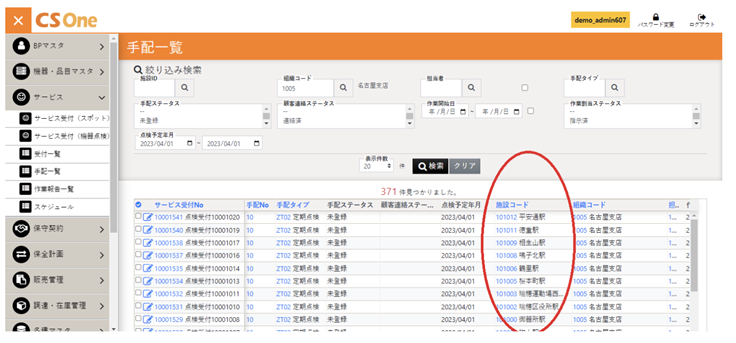
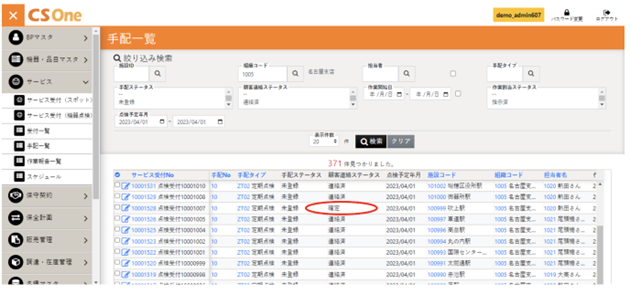
We set the Tokai region and the Kansai area as dispatch bases. To distribute jobs in a well-balanced manner, we assumed that each station across all private railway and subway lines in both regions would be a service location. Based on this, we registered maintenance contract master data in CSOne to generate approximately 350–400 inspection jobs per month.After executing the bulk inspection planning process, we reviewed the April 2023 inspection schedule in the assignment list. In the figure below, you can see that inspection plans have been created for subway stations within Nagoya City.
Step2) Execute Dispatch (With Relaxed Constraints)
We registered 10–15 field technicians per dispatch center, initially without setting any constraints such as skills or shift schedules. Each inspection job was assumed to take one hour, and the available service time window was broadly set from 10:00 to 17:00.For daily starting locations, we set Nishinomiya City as the base in the Kansai area, while in the Tokai region, starting points were distributed across several JR stations.
With these conditions in place, we proceeded to run the dispatch.
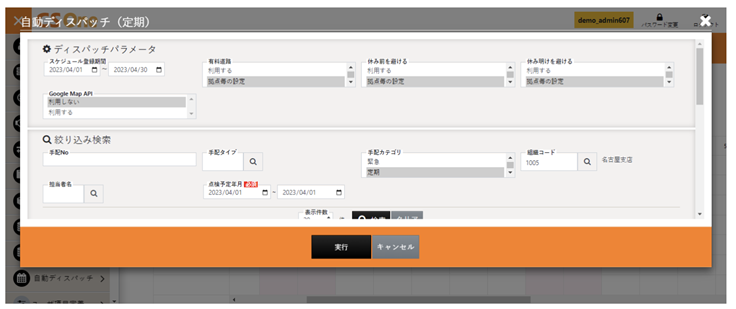
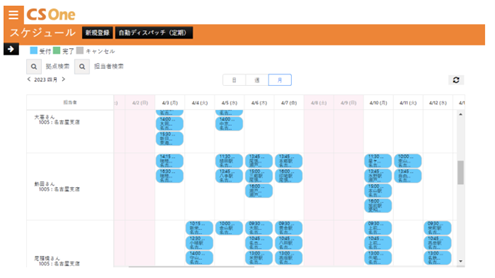
CSOne’s built-in algorithm automatically generates schedules with the optimal routes and technician assignments. The figure below shows the results for the Tokai region.
Each technician is assigned approximately 2–4 jobs per day, with tasks distributed across multiple service staff while taking travel efficiency and routing into account.
Manual adjustments can also be made on this screen using drag-and-drop functionality. Additionally, a distribution map is available to visualize which areas each technician is responsible for. This map represents the distribution of assigned jobs over the course of April 2023, with each technician distinguished by a different color.
<Technician Distribution Map – Monthly – Tokai Area>
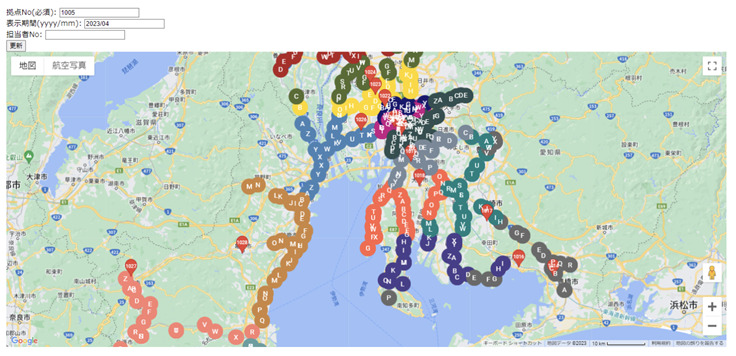 Since almost no constraints were set other than the service locations and technicians’ starting points, jobs are generally assigned in clusters near each technician’s base location.
Next, let us see Kansai Area.
<Technician Distribution Map – Monthly – Kansai Area>
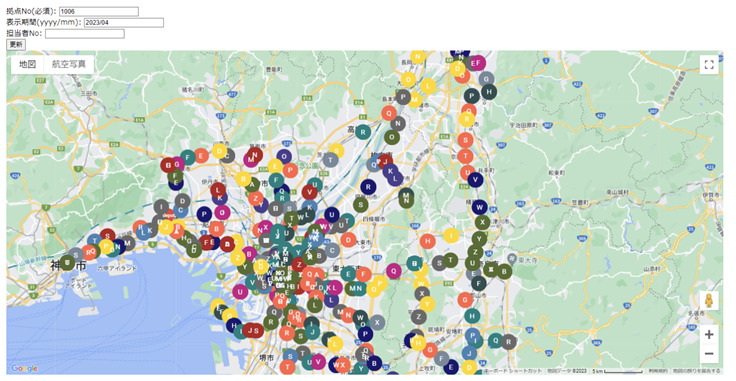 The schedule table, similar to the Tokai region, assigns 2–4 jobs per technician per day, with appointments evenly distributed throughout the month rather than concentrated on specific dates.<
Unlike the Tokai region, where starting points were distributed, the Kansai area uses a single starting location in Nishinomiya City. As a result, when viewing the monthly distribution map by technician (color-coded), there are no clear clusters by area.
However, when focusing on an individual technician’s distribution map, it becomes clear that visits are grouped by date, with nearby locations scheduled on the same day to ensure efficient routing.
<Technician Distribution Map – Daily – Kansai Area>
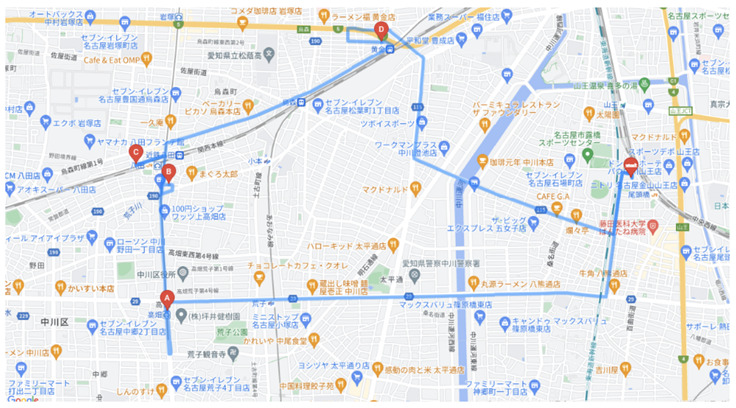
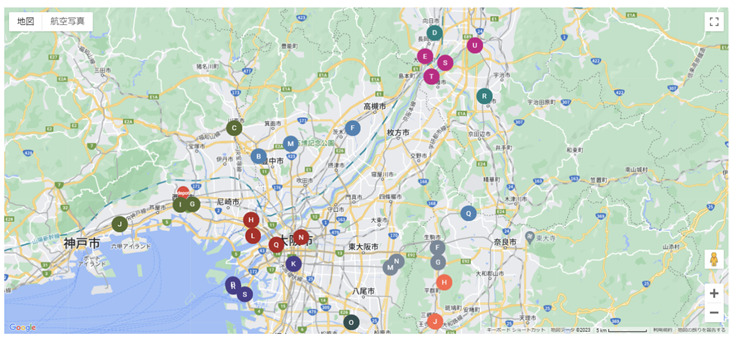 Next, returning to the Tokai region, we examine the route map for a specific technician on a specific day. The route is automatically generated to allow efficient visits to nearby job sites (automatic routing).
Since each task is set to take one hour, when multiple jobs are located within close proximity, the system enables technicians to complete a higher number of assignments in a single day.
<Route Map by Technician>
Step3) Execute Dispatch (With Tight Constraints)
So far, dispatch has been executed with almost no constraints other than service locations and technicians’ starting points. Now, we introduce additional constraints and run it again.For technicians at the Nagoya branch, shift schedules are defined with various patterns such as morning-only shifts, days off, and afternoon-only shifts on a daily basis.
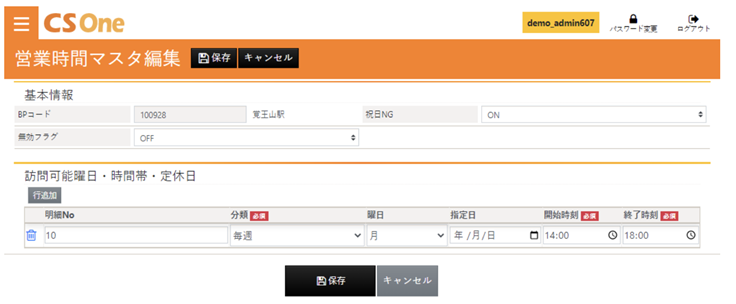
For service locations, available visit time windows are also configured with different patterns—for example, AM only, PM only, or AM and evening only for subway stations in Nagoya City.
With these constraints in place, we execute the dispatch again.
<Technician Schedule>
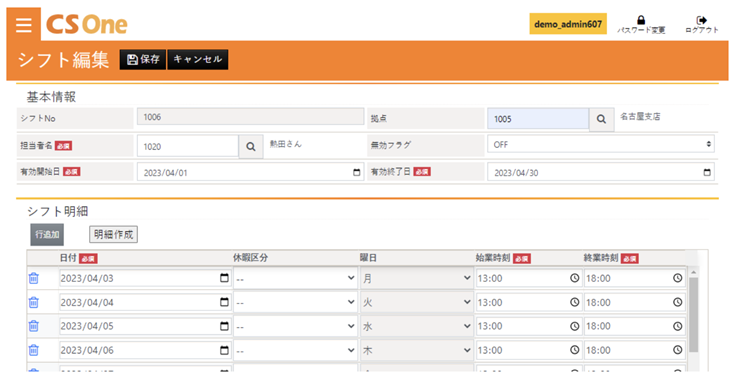 <Available Visit Time Windows at Installation Sites>
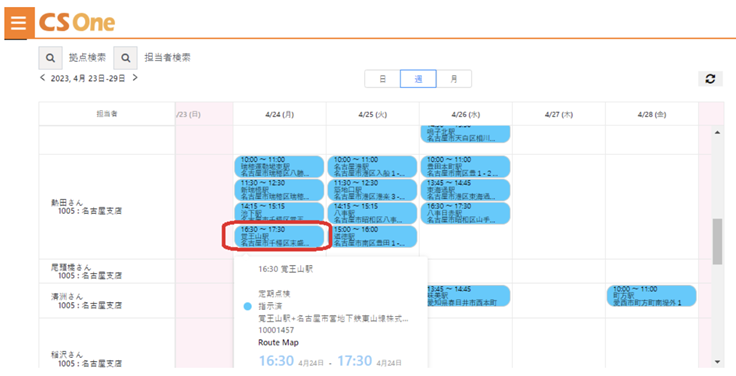
 Let’s review the scheduled visit for Kakuozan Station, where the available time window was set from 14:00 to 18:00. After completing inspections at nearby stations, the system scheduled the technician to arrive at 16:30.
The technician, Atsuta-san, who is assumed to reside in Nagoya, has a weekday shift from 13:00 to 18:00. As shown, the task is completed within the assigned shift, demonstrating that both time window constraints and work schedules are properly respected.
<Schedule Considering Technician’s Schedule and Available Visit Time Windows>
 In addition, CSOne allows you to configure various constraints such as technician skills, supported equipment types, and designated personnel for specific service locations.
After setting these constraints and running the automatic dispatch for October 2023—using the same inspection plan as April 2023—the results are shown below.
<Distribution Map After Applying Constraints>
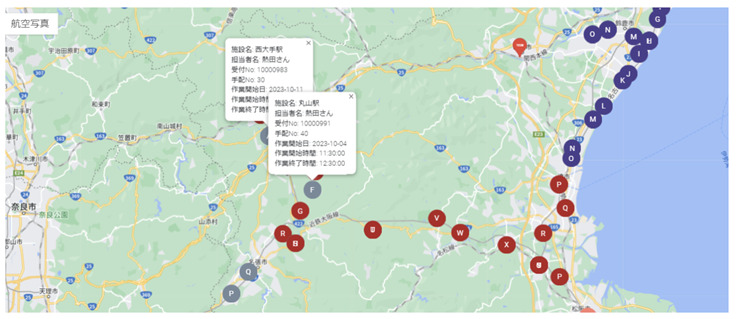 In this sample, the Iga area is located far from the starting points of many technicians. For some jobs in this area, we intentionally set a skill mismatch for technicians residing around Iga.
As a result, those technicians are not assigned to these jobs, and instead, technicians from other regions are scheduled to travel and handle the work. This confirms that the system properly accounts for skill constraints when generating assignments.
Step4) Notifying the Customer
According to dispatch coordinators on-site, notifying customers and coordinating schedules after creating visit plans also requires significant effort.With CSOne, users can review automatically generated schedules, make manual adjustments if needed, and then send bulk notifications to customers. The system also allows receiving responses from customers.
While rescheduling that requires direct communication cannot be fully automated, for many customers who accept the initially proposed dates, the process—from notification to confirmation—can be significantly shortened.
<Sample Customer Notification Email>
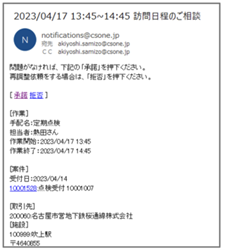 <After Customer Confirmation Click>
Summary
CSOne automatically generates visit plans by considering various constraints that dispatch coordinators typically account for when creating schedules. In some companies, assigning around 2,000 monthly jobs to approximately 100 technicians requires 15–20 dispatch coordinators to handle scheduling.By using CSOne’s automatic dispatch, planning for around 400 jobs per site can be completed in as little as 10 minutes. Even if about 20% of jobs require customer coordination, automating the remaining 80% significantly reduces the workload. Although initial setup such as master data preparation requires effort, continuously reducing dispatch-related labor—typically a fixed cost—leads to substantial productivity gains.
Another key advantage is standardization. By systemizing dispatch operations, tasks that previously depended on experienced personnel with knowledge of geography and technical requirements can now be handled by anyone, regardless of experience level.
In companies where technicians are assigned to specific customers or locations, scheduling may be left to individual technicians. However, this approach creates risks—such as knowledge loss when employees leave, transfer, or take extended leave, as well as potential over-familiarity with specific clients. Moreover, simply distributing dispatch tasks among technicians does not improve overall organizational productivity.
For these reasons, dispatch operations should ideally be handled by dedicated coordinators and supported by a system to ensure speed and efficiency. If you are facing challenges in managing technician dispatch, please feel free to contact us. We would be happy to propose solutions tailored to your specific needs.
For more information, including “Request Materials”, please refer to the links below.