

Efficient management of routine inspections and maintenance planning is essential for building customer trust in field service operations while maximizing revenue opportunities for businesses. In this article, we explain practical solutions for managing routine inspections and maintenance planning efficiently, based on the CSOne Field Service Management system.
Key Challenges in Routine Inspections and Maintenance Planning
Routine inspections are mandatory services that must be fulfilled for customers. For this reason, they must be carried out without oversight; however, in practice, they are often not sufficiently managed, leaving companies exposed to the risk of non-compliance. In addition, dispatching field technicians for routine inspections requires significant resources and costs, and in many cases these dispatch operations are not fully optimized.
On the other hand, maintenance planning is not mandatory, but structuring this process can have a substantial impact on a company’s profitability. Many organizations have not fully implemented preventive maintenance and instead rely primarily on reactive, after-the-fact responses once failures occur. As a result, resources such as personnel and spare parts cannot be leveled or optimized effectively, leading to significant lost revenue opportunities.
CSOne Solution for Routine Inspections
By using CSOne, a field service management system, routine inspections can be managed efficiently and without oversight. In the following section, we explain this solution step by step, divided into three stages, while showing actual screens from the CSOne system.
Step 1) Registering the Maintenance Contract Master Data
In this example, let us assume that you enter into a maintenance contract for a boiler installed at the Tokyo Factory of a fictional customer, JR Tokaido Main Line Co., Ltd.
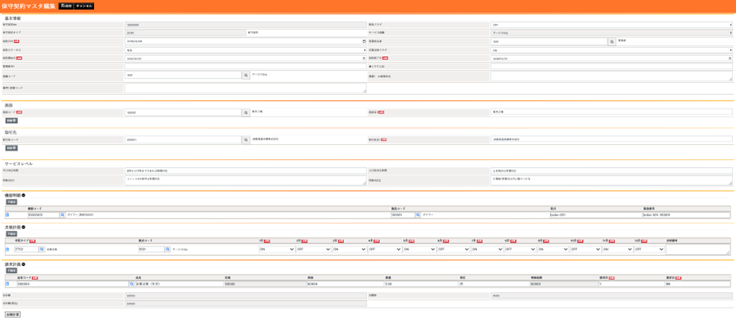
First, you register the maintenance contract master. Enter the basic information, including the contract date, start date, and end date, and then select the relevant facility code and customer account code.
The service level can be customized freely. By recording details such as response hours on weekdays and holidays, as well as any special service requirements, even staff members who are not familiar with the customer can provide an appropriate minimum level of service.
Next, select the installed boiler in the equipment details section. In many cases, when field technicians visit a factory for inspections, multiple pieces of equipment are installed on site, making it difficult to determine which equipment is covered under the maintenance contract. By properly registering the contracted equipment in the system, technicians can accurately identify the applicable equipment on site.
In the inspection planning section, select Routine Inspection as the dispatch type. For example, if inspections are required once every two months, you can simply set January to ON, February to OFF, March to ON, and so on, to complete the registration.
Finally, register the billing plan by entering the fee for routine inspections. Since CSOne provides not only routine inspection management but also built-in sales management functions, defining the billing plan in the master data enables easy invoice generation. In other words, CSOne allows you to manage everything—from routine inspections and sales to administration and payment collection—in a single integrated system.
Step 2) Dispatching Routine Inspections
With the maintenance contract master registered in Step 1, the next step is to carry out routine inspections—namely, dispatching field technicians. Dispatch operations are widely recognized as highly resource-intensive. For example, if a company manages 2,000 cases per month with 100 field technicians and performs dispatching manually, it would require nearly 500 hours of dispatch work. In an era where AI has advanced significantly, this use of resources is an area that should be reconsidered.
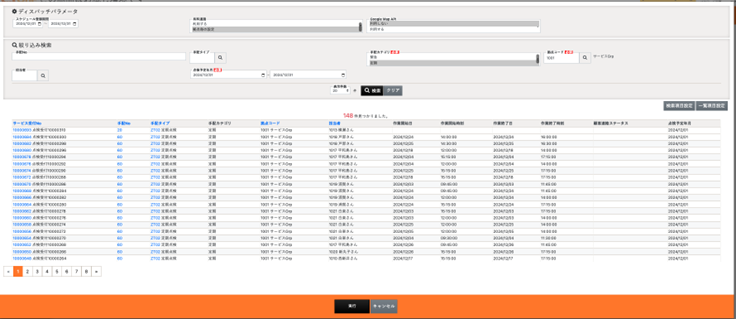
By using CSOne’s automatic dispatch feature, dispatch efficiency can be dramatically improved. Let us assume that you are dispatching routine inspections for December. First, enter the required conditions into the system. Set the schedule period from December 1 to December 31, 2024, and select Routine as the dispatch category. When you click “Search,” the system shows that 148 routine inspections need to be performed in December.
Next, click the Execute button at the bottom of the screen to start AI-based automatic dispatch. Taking into account technician location based on positional data, daily schedules, travel distance, and individual skills, the AI automatically determines which field technician should visit which factory for routine inspections.
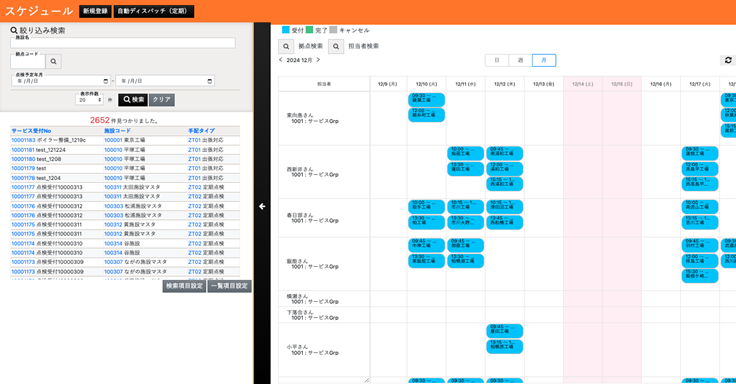
As a result, the system proposes the schedule in the form of the calendar shown below. Field technicians are listed along the vertical axis, and the blue blocks represent the jobs assigned for routine inspections.
For example, Technician Higashi Mukojima is scheduled to conduct a routine inspection at the Ayase Factory on Tuesday, December 10, from 9:30 AM, followed by another inspection at the Kinshicho Factory starting at 12:00 PM. Since this schedule is managed in the cloud, anyone with the appropriate access permissions can view the technicians’ schedules.
In addition, even if a customer requests a sudden schedule change, rescheduling is extremely easy—simply drag and drop the corresponding blue block to adjust the schedule.
Step 3) Performing Routine Inspections
Finally, we explain how routine inspections are carried out by field technicians. Let us assume that Technician Higashi-Mukojima, introduced in Step 2, visits the Ayase Factory to perform a routine inspection. The equipment installed at the Ayase Factory is a boiler.
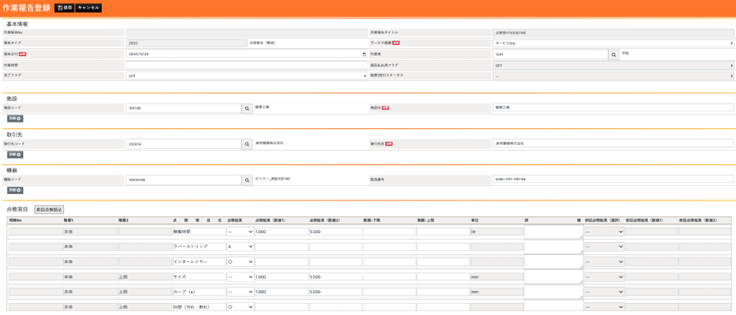
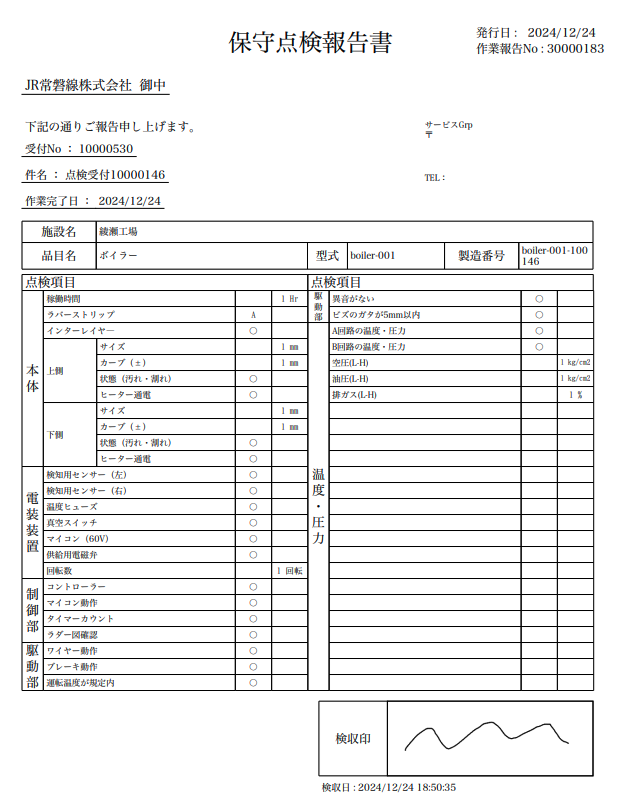
Below is the work report entry screen. One key point to note is the inspection checklist. The inspection items required for routine inspections are automatically displayed based on the combination of the equipment and the dispatch type registered in the maintenance contract. In this case, the combination of “Boiler” and “Routine Inspection” automatically proposes the inspection items that the technician needs to check.
Following these items, the technician enters the inspection results using appropriate values such as letters, symbols, or numbers. By verifying objectively required inspection items rather than relying on individual skills or experience, the system enables companies to fulfill their maintenance contract obligations accurately and without oversight.
As long as field technicians have a tablet or other mobile device, they can obtain the customer’s signature directly on site. A formal inspection report in PDF format—containing the inspection results for each checklist item explained earlier—can be generated with just a few clicks and sent via email or fax.
This eliminates the need for technicians to return to the office to prepare reports after completing inspections, thereby significantly improving field technician productivity.
CSOne Solution for Maintenance Planning
Next, we explain maintenance planning using the CSOne Field Service Management system. By shifting from a reactive approach—responding only after equipment failures occur—to a proactive, proposal-driven approach, companies can significantly increase revenue opportunities. This transition can be achieved through the following two steps.
Step 1) Registering the Bill of Materials (BOM) Master
First, register the parts installed in the target equipment as a Bill of Materials (BOM) in the master data.
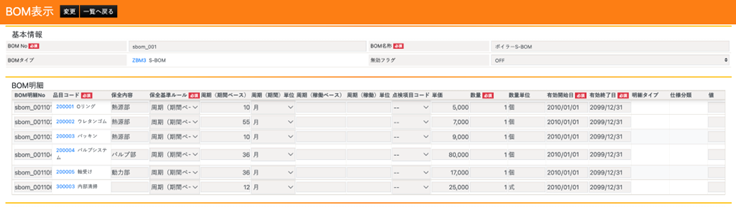
In this example, we assume the equipment is a boiler. As shown in the example, the boiler consists of six components: O-rings, urethane rubber, gaskets, a valve system, bearings, and internal cleaning.
For each component, enter basic information such as inspection intervals, unit prices, and installation dates to complete the master registration. In this example, the inspection criteria are based on time periods; however, inspection cycles can also be defined based on operating hours, usage pace, or other criteria suitable for each component.
In addition, to make management and operation easier for each customer, BOMs can be created by equipment model group, or managed in more detail by creating and maintaining BOMs individually for each specific piece of equipment.
Step 2) Pre-Check of the Maintenance Plan
This step involves the checks that should be performed before field technicians visit the customer site for routine inspections or other service activities.
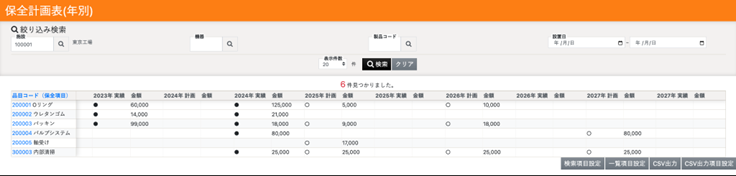
Open the maintenance planning table on the management screen and select the relevant factory. In this example, select the Tokyo Factory where the boiler registered in Step 1 is installed. The screen then displays actual results and planned activities for each component. Black circles indicate parts that have already been inspected or replaced, while white circles represent items scheduled for future inspection or replacement.
Even busy field technicians can instantly identify which parts should be proposed for replacement at the next visit. For example, according to the 25-year maintenance plan, O-rings, gaskets, bearings, and internal cleaning are scheduled, allowing technicians to proactively prepare replacement proposals in advance and expand revenue opportunities.
Although the amounts in this example are relatively small, customers often cannot make immediate decisions on high-cost work such as overhauls, which can cost several million yen. By making proposals with sufficient lead time, the likelihood that customers will allocate budget in the following year increases significantly.
In this way, by implementing CSOne, companies can move beyond being consumed by short-term repair work and instead shift toward proactive, future-oriented proposals—leading to increased revenue and stronger, long-term customer relationships.
Case Study|Showa Manufacturing Co., Ltd.
By replacing its aging system with the latest CSOne platform, Showa Manufacturing Co., Ltd.. reviewed and restructured the management of maintenance contracts and maintenance planning, successfully building a lifecycle-based business that includes after-sales service.
By utilizing CSOne not only for maintenance contracts and maintenance planning but also by integrating customer management and sales management, the company significantly improved both operational efficiency and profitability. This stands as a strong success story of CSOne implementation. For more details, please see the full case study here.
Conclusion
As outlined above, effective management of routine inspections and maintenance planning is essential for building strong customer relationships and improving profitability. The CSOne Field Service Management system addresses these challenges by streamlining both defensive routine inspections and proactive maintenance planning.
In addition, CSOne comprehensively covers not only routine inspections and maintenance planning, but also other essential field service operations such as spot work, sales management, and inventory management. This enables companies to manage all field service activities in an integrated manner within a single system.
We would be happy to propose a solution tailored to your specific challenges. Please feel free to contact us for more information or a consultation.