

Field service operations require fast decision-making and rapid responses to customer requests. However, with traditional paper-based work reports and non-integrated data management systems, it often takes too long to retrieve the information needed to provide optimal service. This can directly lead to lower customer satisfaction and may negatively affect a company’s brand value.
In this article, we take a closer look at how the implementation of a field service management system can fundamentally transform the efficiency of case management and improve customer satisfaction.
4 Key Challenges
1. Managing Case Progress and Status:
To execute field service operations efficiently, proper management of case progress is essential. However, in many companies, cases do not proceed as planned, leading to missed opportunities and decreased customer satisfaction.For example, even after providing a quotation to a customer, delayed responses can create uncertainty, requiring careful follow-up and communication. Additionally, even when a formal order is received, delays in arranging work or allocating resources can result in project setbacks.
Furthermore, even after work has been successfully completed, if invoices are not issued properly, it can create issues in revenue recognition and cash flow management. To address these challenges, companies need to strengthen customer communication, optimize work planning and resource allocation, and automate billing processes. By implementing an effective progress management system and improving processes, both operational efficiency and customer satisfaction can be significantly enhanced.
2. Efficiency of Information Management:
To respond quickly to customer requests, it is crucial to access essential information—such as equipment location, specifications, maintenance contract details, and service history—without delay. However, in many organizations, this valuable data is still stored in paper-based formats or fragmented across multiple systems, making centralized management difficult.As a result, retrieving necessary information takes time, which can delay responses to customer inquiries and increase the risk of dissatisfaction. Paper-based records are also vulnerable to damage and loss, raising concerns about data security and continuity. In some cases, critical information depends on individual memory, making it inaccessible when key personnel are unavailable.
These issues directly impact service quality and can harm a company’s reputation. Therefore, digitizing information and integrating systems are essential not only for improving operational efficiency but also for enhancing customer satisfaction.
3. Searching Service History:
When failures or customer inquiries occur, quickly understanding how similar issues were resolved in the past is critical to improving service quality. Efficient access to historical data is key to rapid problem resolution and minimizing customer downtime.However, in many cases, reliance on paper-based records or non-integrated systems makes it difficult to search for important historical information. This results in time-consuming searches and increases the risk of overlooking critical data.
Moreover, dependency on individual knowledge hinders information sharing, and when certain personnel are unavailable, necessary information may become completely inaccessible. This leads to inconsistent service quality and can damage customer trust.
To maintain a consistent level of service, fast and reliable access to historical data is essential. Achieving this requires rethinking data management processes and leveraging modern technologies to digitize and centralize information.
4. Access to Information in the Field:
For field technicians, immediate access to up-to-date information is essential for quickly resolving customer issues and delivering high-quality service. However, in many cases, the information they need is only available within office systems, limiting accessibility in the field.This makes real-time problem-solving difficult and disrupts workflow. For instance, if a technician must contact the office, request data, and wait for a response while on-site, it clearly results in wasted time. Similarly, having to bring important documents back to the office creates significant delays in the workflow.
In terms of reporting, if technicians cannot complete reports on-site, it leads to duplicate work, wasting both time and effort.
These limitations in information access not only delay service delivery but also reduce customer satisfaction. Customers expect quick responses, and delays caused by limited access to information fail to meet those expectations.
In modern field service operations, it is essential to adopt cloud-based systems and mobile devices that allow technicians to access necessary information anytime, anywhere. By implementing a field service management system, these challenges can be effectively addressed.
With a cloud-based platform, information becomes accessible from any location and on any device, streamlining workflows and significantly improving productivity. Centralized data management enables rapid retrieval of relevant information, allowing teams to quickly access the data needed for problem resolution.
Benefits of Improving Case Management Efficiency
1. Transparency in Case Management and Maintenance Contracts:
By implementing a field service management system, the progress of cases and the details of maintenance contracts become clearly visible, increasing operational transparency across the organization.In traditional management approaches, issues such as submitted quotations remaining without clear order status, or completed work not being invoiced, were common. However, with a field service management system, case statuses are visualized and alerts are automatically generated for incomplete tasks, enabling cases to progress as planned.
In addition, maintenance contracts—including contract types, validity periods, and service levels—are stored in a centralized database, allowing both managers and field technicians to access them easily. This ensures appropriate service delivery based on contractual terms and enhances reliability for customers.
Improved operational transparency leads to greater trust and efficiency. Clear management of case progress and maintenance contracts enables cost reduction and optimal resource utilization.
2. Centralization of Data:
The implementation of a field service management system enables the centralization of data.Traditionally, company information has been scattered across various locations and formats. Equipment installation details, service histories, and contract information were often stored in paper files, making management inefficient and time-consuming when retrieving data. In addition, differences in data formats made it difficult to integrate and utilize information effectively.
With a field service management system, all data can be centralized and managed in a unified format. This is a critical step toward improving data visibility. For example, when receiving an inquiry from a specific customer, the system can display installation details, contract information, and service history in one place. This centralization allows technicians to quickly understand the overall situation and respond accurately to customer needs.
Furthermore, executives and managers can leverage centralized data to support strategic decision-making. Integrated data can be easily used in analytical tools, enabling better business insights and more informed decisions.
By centralizing data, companies can enhance information visibility and accessibility, establish faster and more accurate workflows, and strengthen their competitive advantage.
3. Real-Time Access to Information:
The implementation of a field service management system enables immediate access to critical information, bringing significant advantages from multiple perspectives.First, field technicians can access the necessary information in real time when responding to customer inquiries. For example, if a customer reports an issue with a specific piece of equipment, the technician can quickly check its installation location, specifications, and maintenance contract details. This enables faster problem resolution and improves customer satisfaction.
In addition, contract information and past service history can also be accessed in real time. This allows technicians to understand the customer’s current contract status and previous service records, enabling appropriate responses and proposals. By referencing historical data, they can also determine whether similar issues have occurred before and implement effective countermeasures.
Real-time access to information improves communication with customers and accelerates problem resolution. As a result, it helps build customer trust and enhances overall competitiveness.
4. Data-Driven Analysis and Proposals:
By implementing a field service management system, centralized data becomes available for analysis. This data can be used to identify failure trends by equipment and analyze defective products.First, companies can gain insights into failure patterns for each type of equipment. The system records service history, and if certain equipment shows frequent failures, this trend can be clearly identified through data.
This information is highly valuable when planning preventive maintenance. By conducting regular inspections and maintenance based on these insights, companies can reduce the risk of failures and deliver higher-quality services to customers.
Furthermore, data-driven decision-making supports new contract proposals. By analyzing customer needs and service history, companies can propose valuable new services or upgrade options, creating opportunities to increase revenue.
Finally, data-driven approaches enable the optimization and leveling of internal resources and inventory. By allocating service resources appropriately and reducing unnecessary inventory and operational waste, companies can improve cost efficiency.
Through a data-driven approach, companies can maintain competitiveness and achieve sustainable growth. Data-driven decision-making is one of the key factors driving transformational change in field service operations.
Summary
As a conclusion, implementing a field service management system is not only about solving existing challenges; it also provides a significant opportunity to enhance a company’s service delivery capabilities and improve the productivity of each employee.By improving case progress management, real-time access to information, searchability, and data accuracy, companies can increase customer satisfaction while achieving greater operational efficiency. Furthermore, data-driven decision-making enables organizations to identify future business opportunities and strengthen their competitive advantage. The adoption of a field service management system has become an essential investment in modern field service operations.
CSOne’s field service management system enables centralized management of digitized customer information, allowing field technicians to easily search and access customer data on-site. For example, by using a machine number provided during a customer inquiry as a key, technicians can instantly retrieve customer details such as installation location, machine specifications, and installation date. In addition, since past service histories are accumulated within the system, it is also possible to check whether the same parts have repeatedly caused issues, enabling more accurate and effective responses.
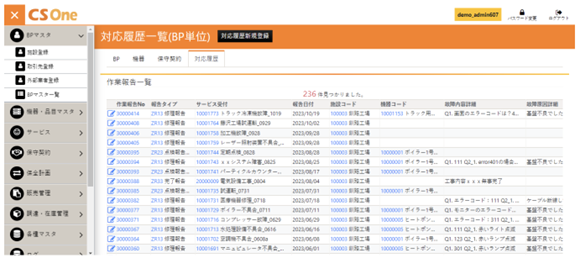 CSOne’s field service management system is equipped with features designed to improve the efficiency of your operations. It has been widely adopted by many customers and has received recognition such as the ASPIC IoT, AI & Cloud Award – Best Innovation Award.
For more information, including “Request Materials” , please refer to the links below.
If you are facing challenges in managing service operations or case management, please feel free to contact us. We will provide tailored proposals based on your specific business needs. For more information, including “Request Materials” , please refer to the links below.